
Municipal solid waste management in Melpattampakkam, Cuddalore District, Tamil Nadu
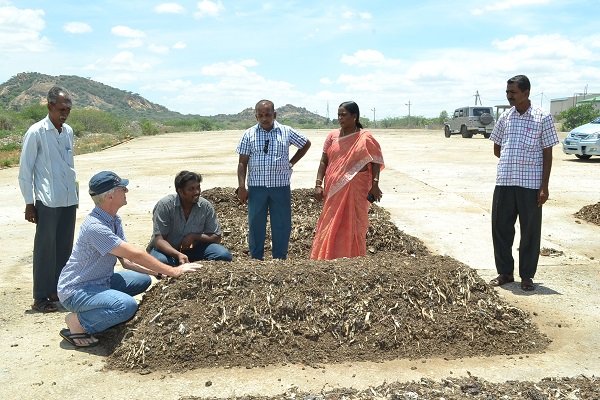
Municipal waste Melpattampakam
2007-2009
In July 2007 EcoPro responded to a request by the then Chairman of the Town Panchayat Melpattampakkam to help in upgrading the town’s waste management services, specifically in setting up a waste segregation facility or rather, a resource recovery centre (RRC). As the Chairman was extraordinarily motivated to set up quality services that would achieve optimum environmental benefits, and as his enthusiasm spread to all co-workers, it was a pleasure to collaborate with him and the team on site. For work at the RRC, a women self help group (SHG) was employed, whose members were receptive to all advice and cooperative in setting up an exemplary centre.
Steps taken
- Mixed household waste was collected and dumped next to the RCC; when compost heaps were built up, large and easily recognizable non-compostable items were removed; smaller items were removed when the heaps were turned, which happened at least twice during the process of composting.
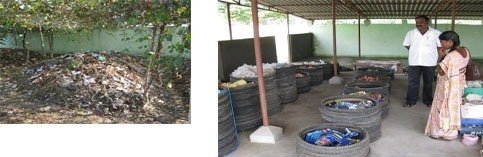
- Non-compostable, non-organic waste items were sorted and stored in segregated batches, which recycling agents were happy to collect and buy. Segregation of different waste streams was adjusted to the extent at which recycling industries asked for them.
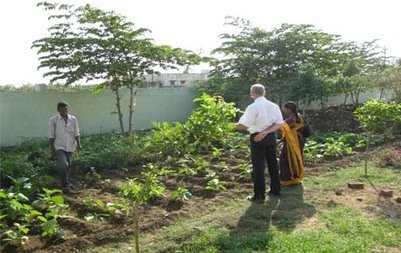
- The organic waste freed from its non-compostable immixture was given the time to turn into mature and stable compost, some amount of it by vermicomposting (composting with the help of earthworms). Most of the compost was used to grow vegetables within the campus of the RRC.
- The offensive smell of decomposing organic raw materials and the associated fly nuisance were completely eliminated by spray applications of activated EM solution. The women of the SHG and workers at the vermicompost beds were proud and happy that their working place had become a well-arranged, odour-free scene, where tea breaks and snacks could be enjoyed in an atmosphere of pleasurable hygiene.
Solid waste Solid waste separation into plastic, paper and metal.
Vegetable garden using compost free of non-compostable waste
Impact highlights
- Once municipal solid waste is freed from non-compostable waste items, its composting is easy and rewarding.
- The more non-compostable waste streams can be identified and offered to agents of recycling industries, the more revenue can be created and the portion of residual (non-compostable and non-recyclable waste) can be decreased.
- With the help of spray applications of activated EM solution (AEM) on compost heaps, offensive odor and fly nuisance were eliminated resulting in a dignified work environment making the workers happy and proud of their control of cleanliness.
Challenges and lessons learned
From similar projects in other towns we have learnt that engaging educational sessions in schools have great potential to convince not only students but parents and citizens in general of the importance of waste segregation at source, thus streamlining and simplifying a town’s solid waste management.Text
A leader who is genuinely motivated to improve public wellbeing and enthusiastic in her or his support of activities, can achieve great change within a short time.
Empowering the workers in handling cleanliness and efficacy of work procedures can create the much-needed sense of dignity of manual work, even work with waste.